Alisia woke up feeling tired on Monday. She was in no mood or in no condition to go for a run. But because running was part of her new resolution, she put on her sports shoes halfheartedly. To mark her resolution complete, she ran for almost 4 km on her first day.
Alisia woke up tired again on Tuesday. However, this tiredness was due to the run. This is a good thing, right? But every muscle in her body seemed to be screaming in pain. Despite her willingness, she couldn’t run that day or the next. In fact, her body was sore for the entire week.
Resolutions are a favourite among human beings. In my opinion, the trend of resolutions is as old as the trend of celebrating the New Year. However, there goes a joke: Resolutions are meant to be broken! According to EHM Tech, only 9% of Americans stick to their New Year Resolutions throughout the year. Around 80% quit their resolutions by February. Strange, isn’t it?!
What if I told you that there is something better than resolutions? Unlike resolutions, you need not bring about a drastic change in your lifestyle. Also, you need not wait for first of January or a Monday to keep your promise to yourself. I Alisia know, this has made you sit up and take interest. Introducing Micro Habits – small, simple adjustments to your lifestyle that will make you healthier and happier, without bigger commitments, a.k.a. Resolutions.
The Myth of Total Transformation
We live in a world obsessed with monumental shifts. The first day of the year, month or week seems ideal for introducing a drastic change in our lives. But when we don’t start on the day we decided on earlier for some reason, we burden ourselves with guilt.
The truth is, Total Transformation is not possible unless we make small, tiny shifts in our lives. These changes, simple as they might seem, add up to big changes if we stick to them. After all, small changes have been credited with making a big impact, haven’t they?
A Sneak Peek from My Old Lifestyle
I used to wake up at 6.30 am earlier. Suddenly, one day (after a messed-up morning), I decided to wake up at 4.30 am. Yes, 2 hours earlier. Now, you might be antsy to know whether I did wake up early. The answer to this is no.
Not only did I not wake up at 4.30 am, but not at 6.30 am either. I over-committed myself to waking up early. My friend suggested I should have got up at 5.30 the next day, then set the alarm to 5 am the day after, and 4.30 the day after that. Gradual transformation helps us stay committed. And here comes the role of micro habits that helped transform my routine completely.
What are Micro Habits?
Micro habits are tiny actions that we build into our routine for actionable results. These actions don’t require much effort yet result in major transformation over a period of time. Basically, micro habits take around two minutes or less to complete yet serve as major building blocks for lifestyle transformation.
For instance, when we are not able to put an entire pizza in our mouth, we break it into tiny morsels that our mouth can fit. Similarly, when we are not able to induce a sudden change in our lifestyle, we resort to micro habits. As they are simple to follow, the brain does not fear adopting these habits.
Why are Japanese Micro Habits trending?
Japanese culture believes in bringing calm to daily routines through tiny micro-habits, rather than sweeping life overhauls. For Japanese people, incremental consistency matters more than sudden transformation. Japanese micro-habits result in reduced friction and improved well-being.
Kaizen approach in Japanese culture is rooted in the concept of continuous 1% daily improvement. When the goal is big, it requires strong motivation to begin it. Instead, in Kaizen, the barrier to entry is reduced. One needs to start low and slow, gradually making the change a habit rather than hard work.
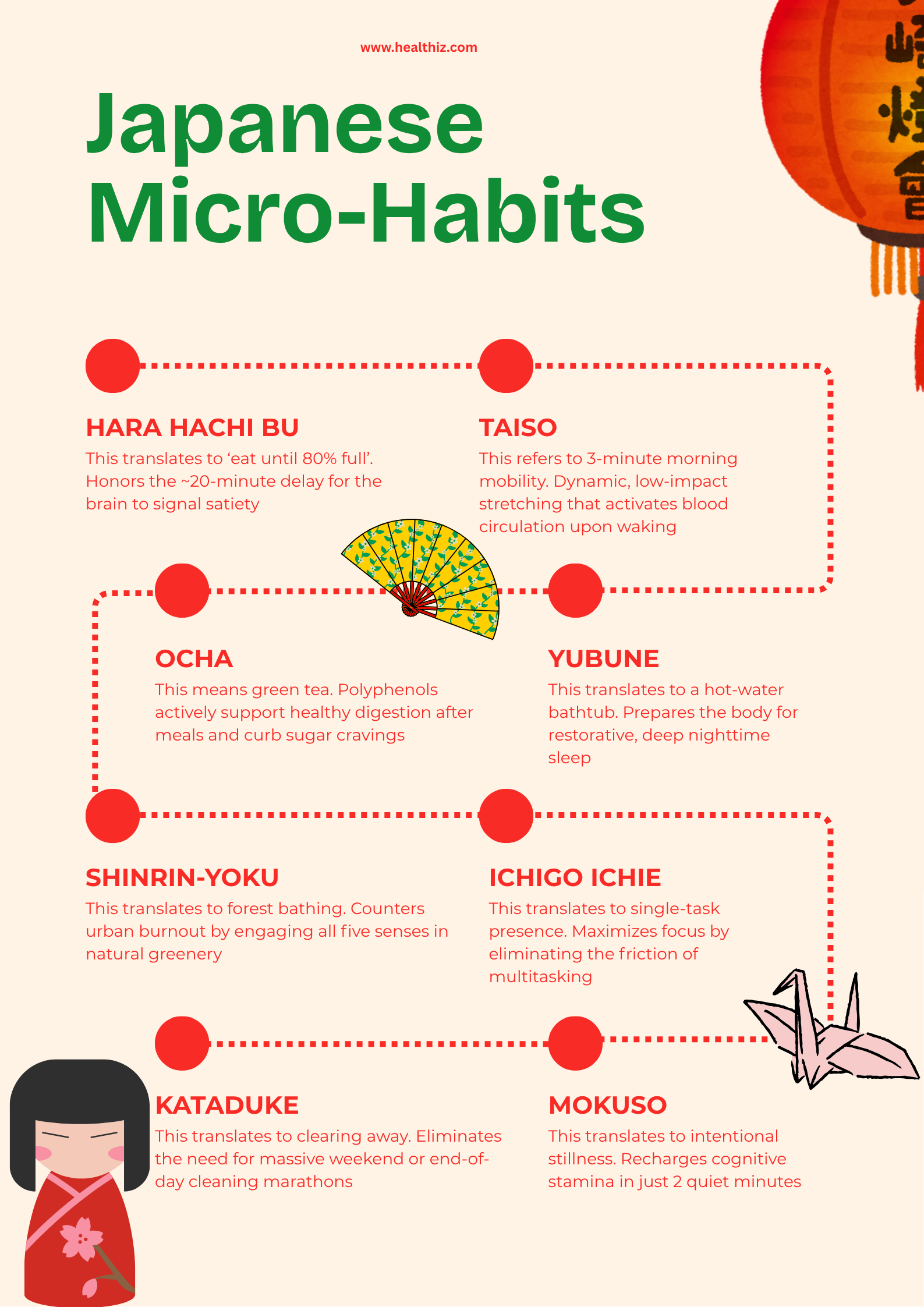
Transform Your Health with these 5 Japanese Micro-Habits
#1 Hara Hachi Bu
This translates to eat until 80% full. It is recommended to eat only till you feel 80% satisfied. Instead of stuffing ourselves with food, Japanese culture recommends enjoying food and keeping a little space. Even when we are 100% full, we will not realize it instantly. It takes around 20 minutes for the brain to decipher that the body is satiated. This is a simple rule and helps in effective digestion and sustained energy throughout the day.
#2 Taiso
This refers to 3-minute morning mobility. Taiso is a dynamic calisthenics routine that is low-impact yet powerful. Practiced across schools, offices, and parks in Japan, Taiso is 3 minutes of exercise that helps stretch the body upon waking up. It helps activate circulation sans any workout gear. Instead of committing to two hours of strenuous exercise on day one, you can start small by committing to just 3 minutes of stretching.
#3 Ocha
This means green tea. Japanese have a ritual of sipping green tea, i.e. ocha, after meals. Warm and unsweetened green tea (also known as sencha or hojicha) after heavy meals is considered a better option than sugary drinks or dessert. Polyphenols present in green tea aid digestion. They also act as a natural buffer that helps prevent mindless snacking.
#4 Yubune
This translates to a hot-water bathtub. After a strenuous day, people in Japan often take a short hot bath up to the shoulders instead of a quick shower. A typical day at work builds up stress and anxiety. Our bodies take the toll of this pressure. Taking a hot bath stimulates the nervous system while reducing cortisol levels. Yubune helps calm the mind, detoxifies the skin, and relieves muscle pain. It is believed to prep your body for a deep sleep at night.
#5 Shinrin-Yoku
This translates to forest bathing. Our surroundings are gradually turning into a concrete world. Little or no green cover around us makes us weary and anxious. People in Japan make a point to soak in nature regularly to improve both physical and mental health. Shinrin-Yoku involves taking a mindful walk or sitting still in nature or a forest, involving all five senses. This slow-paced time in nature balances the nervous system, reduces stress, and gives mental clarity.
Become Super Productive with these 5 Japanese Micro-Habits
#6 Ichigo Ichie
This translates to single-task presence. In this era where everyone is honing their multitasking skills, Japanese culture proposes focusing on one task at a time. It is believed that the present moment will not return, so one needs to make the most of this moment. During office meetings, if you close secondary browser tabs, you will make the most of your time. When you are talking to someone, put your phone face down and see the magic. Your attention is precious – give it to one task or person at a time.
#7 Kataduke
This translates to clearing away. In many homes, decluttering is a weekly chore. However, in Japanese culture, tidying up and organising is something that needs to be done after every chore. Known as kataduke, it involves cleaning and resetting a kitchen counter, workspace, or centre table completely before moving to the next task. This approach prevents people from waiting for an ad-hoc cleanup session at the end of the day or the week. Kataduke saves time and improves productivity. It even helps in thinking clearly and promptly.
#8 Kakeibo
This translates to a 2-minute daily ledger. When you retire for the day, make a point to jot down your expenses in four buckets viz. Needs, wants, culture, and unexpected. In the present era, when manual writing has become a forgotten activity, Kakeibo proposes that writing manually triggers mindfulness – another forgotten trait. Writing your expenses manually curbs the impulse to spend mindlessly. With this activity, you will not need to undergo the tyranny of complex budgeting apps.
#9 Mokuso
This translates to intentional stillness. Modern lifestyle is tiring not just for the body, but also for the brain. Mokuso suggests taking a two-minute moment of silence regularly. For this, you just need to close your eyes and sit quietly in a place where there are no disturbances. It is advisable to silence your digital devices. When you indulge in Mokuso before starting a major task, it helps centre your mind and calm down your nerves. Alternatively, you can use Mokuso even after the end of meetings and a tiring day at work to declutter your mind and focus.
#10 Yotei Kanri
This translates to night-before planning. In Japanese culture, night-time routines are as important as the morning ones. When you retire for the day, make a habit of writing down the top three important tasks for the next day. When you have written the next day’s work, you sleep without any burden or anxiety. Further, when you wake up, you know what needs to be done right away. Yotei Kanri helps eliminate morning decision fatigue that bothers many people, especially those holding positions at the helm.
The Compounding Magic of Tiny Adjustments
If you are one of those skeptics who believe that drinking a glass of water is not going to change your life, then you must have realized by now how it does. Dramatic reinventions rarely transform human lives, but small changes do. Every effort matters in making a 360-degree transformation possible. Instead of targeting grand gestures that trigger friction and fatigue, strive for tiny adjustments that lead to real, sustainable change.
Japanese culture has been following this approach since time immemorial. With micro-habits built on tiny changes, people in Japan have been making bigger achievements possible. Japanese micro-habits slip into your existing routine quietly, without exhausting you with total transformation in a single day. When you have vowed to stick to a habit, you will realize that habits are the compound interest of self-care.
Even a tiny adjustment to the routine, when followed consistently for more than three months, can eliminate hundreds of micro-stressors, everyday exhaustion, and lethargy in routine life. I would not recommend following all ten habits instantly. However, choose those that fit into your routine and gradually make them a part of your lifestyle. Master the habits until they feel as automatic as breathing, resting your mind.
In a world that demands you do more, make the most of every moment, and overhaul your life completely, the simplest yet effective thing to do is to start small. Your future and calmer self will thank you. Like I thank you for reading this post of mine! Do share it with your loved ones!!