
Ricky is a fairly good student. You can say he’s obedient, disciplined, and intelligent.
It’s 9.30 pm, and he remembers his pending assignment on ‘Climate Crisis’ to be submitted to the school tomorrow.
He doesn’t know what to write as he is unaware of the climate crisis that he is facing.
Facing writer’s block, he was tempted to feed a quick prompt to an Artificial Intelligence bot, and the assignment was ready in seconds.
A quick nip here and an edit there made him sleep peacefully and walk confidently to school tomorrow.
Have you come across a student like Ricky? Or is your child another Ricky in the making?
What’s your next step when you see your child using AI to generate assignments? You are confused, aren’t you? You recall the past when scolding your child ended in a bad argument. It is not a solution. Your child asked for your phone or grabbed the iPad for some research on the topic. And the next minute, AI nudged them to complete the assignment.
Who’s at fault here?
It is not your child’s fault. The research is so good that no amount of hard work on his part will match the in-depth, organized research given by the bot. In addition, even teachers at school love the child who gives a detailed assignment, complete with interesting facts, long paragraphs, and drawings.
Believe it or not, you are not alone in this maze. AI dependency is the newest and most complex frontier of modern parenting. Without a doubt, ChatGPT, Gemini, and Claude have revolutionized efficiency; these boons are gradually becoming a bane, especially for Gen Alpha. These bots have become a cognitive trap for developing minds.
The Magic Wand
Everything was so easy and simple when we started using AI for brainstorming. However, the problem sprouted when these aids mutated (Yes, just like those creatures in Marvel comics) into a mental crutch – for millions of students. Is there a need to struggle through hours of uncomfortable critical thinking when there exists a ‘free’ magic wand? AI can think for me and deliver a friction-free answer, all within three seconds. Magical, isn’t it?
If you are thinking that AI is merely helping your child cheat, you might have your blinkers on. There is a deeper issue lurking here – cognitive atrophy. It refers to gradual loss of mental skills and brain connections due to lack of use. My mom used to joke when I evaded writing a new blog – “Your brains will rust if you do not use them!” Yes, it seemed absurd at that time, but it seems she was speaking the truth. Brains do not rust but become handicapped if not used.
Banning AI is not the solution.
When children do not complete assignments on their own, but outsource their curiosity, logical thinking, problem-solving, and written expression to an algorithm, there’s an issue to take care of. Due to AI, students are missing out on the mental weightlifting needed to build creative confidence, resilience, and reasoning skills.
Yes, AI has crept into our lives like a gentle fog. It is hard to get rid of it. However, as parents, you need to think beyond banning AI or blocking the internet. Instead, you need to cultivate an environment that makes human thinking irresistible.
Why is AI so addictive to a student’s brain?
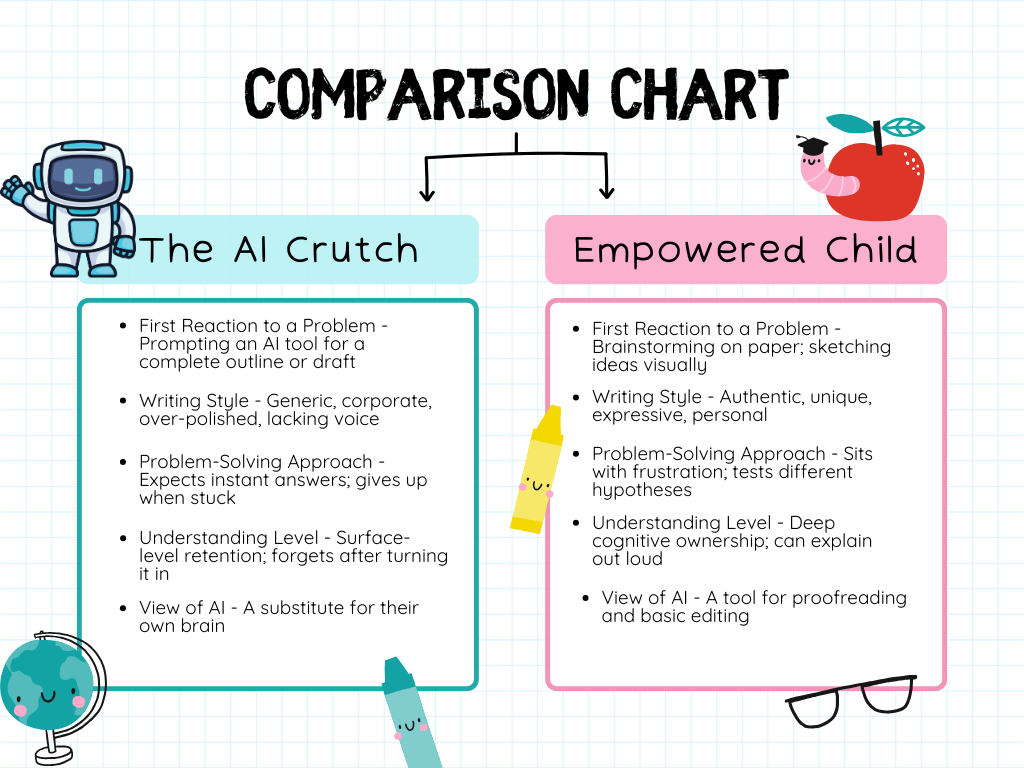
There’s a hidden cost that parents have to pay to allow their children to use the ‘Easy Button ’-Artificial Intelligence. Developing brains are designed to seek efficiency. The objective is to avoid unnecessary discomfort. If you dive deep, you will understand that learning is naturally uncomfortable. It requires a student to sit with uncertainty and wrestle with complex ideas, make mistakes, and edit rough drafts.
Interestingly, AI eliminates the cognitive friction where intellectual growth happens. When students opt for AI to write an essay, solve a math problem, or summarize a chapter, they
- Might lose the stamina required to solve the problem
- Become anxious when the solution is not served to them on a platter
- Sound like a bot devoid of original voice
- Mistake access to information for actual understanding
Brace yourselves, here are 7 creative, zero-fluff strategies you can use to break students’ AI dependency and rekindle their natural cognitive grit.
5 Zero-fluff Strategies to Beat the Bot
As parents, our objective is not to make AI an enemy of our children. We need to teach our children that AI is simply an assistant. It can never become a master of their minds.
1. Discuss and Debate Concepts
Since the introduction of AI, family conversations have become silent. While the family WhatsApp group is rife with memes, forwards, instructions, and updates, real, face-to-face conversations have gone for a toss. Let’s make school assignments a topic of conversation in the family.
The busier we got with office work, the more we lost touch with our children. What if instead of our children, we research the school assignment beforehand? Instead of reminding them to finish their essay, ask them what they think about the topic. Some questions that can be asked about homework –
- What topic would you choose for an essay?
- Is this topic an easy or a difficult one?
- What could be possible angles on which this essay could be written?
- Will you write for or against the topic?
When we stop expecting finished products from our children, but instead participate in the process, they become better thinkers. Such children are less likely to resort to AI to produce a 1000-word essay. It is time we stop looking at our screens and start having conversations with our children.
As parents, our objective is not a pristine digital document but a messy assembly of words that is organic and creative. We should make our children articulate their thoughts and present them in the best possible manner. This will force their brain to process, summarize, and proudly own their work.
Sorted Parenting and Its Benefits – Are You a Sorted Parent?
2. Explore Together
If my friend asks me not to look in a specific direction, I instantly look over there. If I tell my daughter not to use AI, she’s intrigued to use it out of curiosity. Using AI even once is like a lion tasting the blood; it is hard to return to ground zero.
When parents ask me for advice on AI dependency, I always suggest using AI together with their teenagers. This way, both parents and children explore Artificial Intelligence together. It is the same thing when we introduced television to our children, cautiously.
When my 12-year-old is stuck on a topic, and even I am not able to bail her out, we sit together and search for the answers on the internet. We do not just rely on ready-to-use AI answers; we dig deeper to get the big picture.
- We begin by writing a rough draft on paper (yes, an actual written draft, because I do not want her to lose her writing skills)
- Next, we enrich the written draft with facts from the book (yes, we have a good collection of reference books from renowned publications)
- Thereafter, we begin our search on the internet (we check out essays, blogs, and videos)
- The last step is to ask AI to help with more information on the topic (yes, AI is our last resort)
Further, I have taught my daughter to spot AI fluff (repetitive words and sentences that make the content uninteresting to read). She has learnt to decipher the tone (AI content is rife with a robotic tone). As parents, we should educate our children about how AI may not be an authentic source of information.
3. Stimulate the Senses
Being a writer, I know exactly what happens when I begin writing on a topic. The mind goes blank, and at times, I even face writer’s block. I have to resist the temptation to leave the topic. This is what the child faces when they begin writing an assignment.
For a teenager, the hardest part of the assignment is the beginning. She faces cognitive overload, ultimately resorting to AI for ‘inspiration’. The best part of using AI is that it gives a quick jumpstart. However, as soon as we see the ‘ready-to-use’ assignment, it is difficult to work on it and instead submit it as it is.
- For breaking AI dependency, parents need to implement the ‘Analogue First’ Rule
- Teenagers need to begin with drawing mind maps, bullet points, colour-coded ideas, etc.
- Allow them to use sticky notes, markers, paper pins, etc. to arrange their thoughts
- To make this analogue dump, children strictly cannot use the internet
- They are exempt from spelling mistakes, grammar, and all other rules of the language
The beauty of Analogue Dump is that it offers physical movement with tactile engagement. It helps children stimulate different neural pathways rather than typing on a keyboard (which has now become the easiest thing). This helps eliminate the urge to ask AI to begin the project for them.
4. Normalise Imperfection
The real reason behind students’ dependency on AI is acute perfectionism, most of the time. Students in the present era feel intense pressure to deliver perfect and flawless work on their first try. My daughter is disturbed when she has to cancel a word with a wrong spelling. Apparently, she wants to submit neat and flawless work.
This is because AI produces perfect work that is grammatically correct and perfectly arranged. Hence, when students use AI, they unknowingly use a protective shield against incorrect spellings, inadequate research, and incompetence. When a few students use AI to produce perfect work, their classmates feel the need to do the same.
- Parents need to break the myth that learning should look neat
- Explain how if something is easy means it is not helping them grow
- Be an example by showing them your rough drafts (create a dummy rough draft, if need be)
- Assure them that you will always be there to help them work on their rough draft
Parents need to praise their children’s struggle when they strive to give their best, without resorting to AI. Make them understand the science of how the brain builds new neural connections when something feels tough to achieve. When students realize that their teachers value authentic and imperfect human effort over robotic perfection, their anxiety vanishes.
How to Prevent Your Child from Becoming a People Pleaser – Ideas and Advice
5. Avoid Quick Answers
This was a regular homework time scene in our house.
My daughter’s question, “Mom, do you know the name of the largest flying bird?”
My reply, “Ask Alexa!”
Gradually, she skipped asking me questions, spellings, and math solutions. So far, so good. However, there are times when Alexa or Google Home doesn’t know the answer or gives an incorrect one. During such times, my daughter forgets that she can still ask me. She writes the wrong answer or skips the question altogether.
One day, my daughter asked me how our country received Independence. I was tempted to answer her correctly by asking AI to do so. However, I asked her to wait. I wanted to research all the events that led to independence, because it was a cumulative effort of the freedom fighters.
- Knowledge is not a fast commodity to be retrieved but a journey to be explored with the child.
- Resist the urge to ask AI for every answer. Instead, resort to resources and talking to people.
- Always begin with brainstorming theories together with the child.
- Inspire your child by reading books, wrestling with complex hobbies, and writing notes, without resorting to apps.
Children mirror their parents – how they deal with technology, relationships, or people. If your child gets a ready-to-use AI voice-search answer, he might not be able to understand the concepts. Adults need to enjoy the process of thinking and discovering. Normalize being wrong and watch your child learn rather than rush to complete.
The Future Belongs to the Unique Human
Does this sound strange to you? It might. Because, gradually, humans are adopting the traits of robots. One thing that will become precious and rare in the future is Emotional Quotient. If you think that Artificial Intelligence is the villain here, it is not. Passive consumption of information is.
As parents, we should be cautious not to allow our children to rely entirely on AI to form their perspectives, shape their ideas, and solve even the minutest problems they face. By allowing AI to do their homework, we are short-circuiting their cognitive growth.
If this continues, we might raise a generation that knows how to query a prompt, but has forgotten how to wonder. Instead of building a fortress against technology, we should strive to kindle human curiosity, which makes AI seem boring by comparison.
Our objective is to raise independent thinkers. Our children need to have deep empathy and emotional intelligence. Let’s rekindle their out-of-the-box creativity by accepting their unconventional thoughts. We need to build our stamina to help them solve their mess and unstructured work.
Children should understand AI is just a tool, not a substitute for their brains. When we teach our children to trust their minds over an algorithm’s output, we preserve their resilience and cognitive health. Let’s prepare them to thrive in a world where being authentically human is the ultimate superpower.